By Joe

We have now spent most of the last four years living in Lyon, and daily life here is a constant reminder of the French Paradox: How is it possible for the French to eat such rich, fatty food, drink so much alcohol, and not get fat? I will address this later, but I think of greater interest is the American Paradox: How is it that the richest country in the world has such poor health outcomes for its citizens?
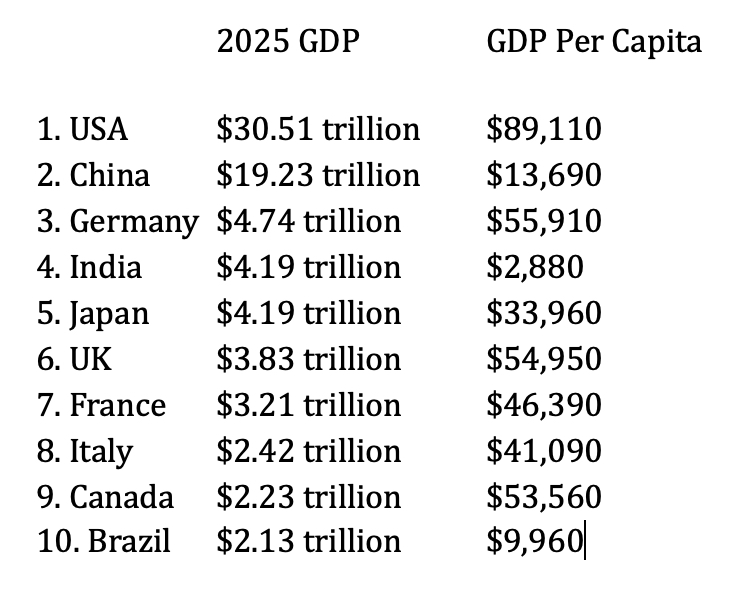
Twenty years ago, the USA had about the same GDP per capita as Western European countries. Since then it has soared, and is now 60% higher than that of Germany, the next highest ranked country. (As an aside, California, if it were a country, would be in 4th place.1)
All this wealth, however, hasn’t benefited Americans. By just every measure of health, America ranks well below the other OECD2 countries, and in some areas is at the level of poverty-stricken Third World countries.
Here are just a few statistics that show how poorly Americans fare compared to other countries:
Life expectancy: At 79.6 years, the USA is 48th out 201 countries, immediately below Albania, one of the poorest countries in Europe. Life expectancy in Japan is 85 years (5-1/2 years longer), Italy 84 years (4-1/2 years longer), France 83.6 (4 years longer).3
Infant Mortality: (number of deaths of infants under one year old in a given year per 1,000 live births in the same year): The USA ranks 55th in the world, just above Romania. The USA’s rate (5.1) is 60% higher than that of France, Germany, and Italy (3.1 each).4
Maternal Mortality: USA 22.5/100,000 live births, France 8.89/100,000.5
Road Traffic Mortality: USA 14.2/100,000, France 4.7/100,000.6
Obesity: Obesity is a growing problem everywhere, but the US is one of the worst. According to the WHO7, 46% of the US population is obese. France: 12.4%8
Hard Work: The average US worker puts in 1810 hours of work per year, 299 more hours (nearly 8 weeks!) than the average Frenchman, who lives 4 years longer. The numbers are about the same for other EU countries9
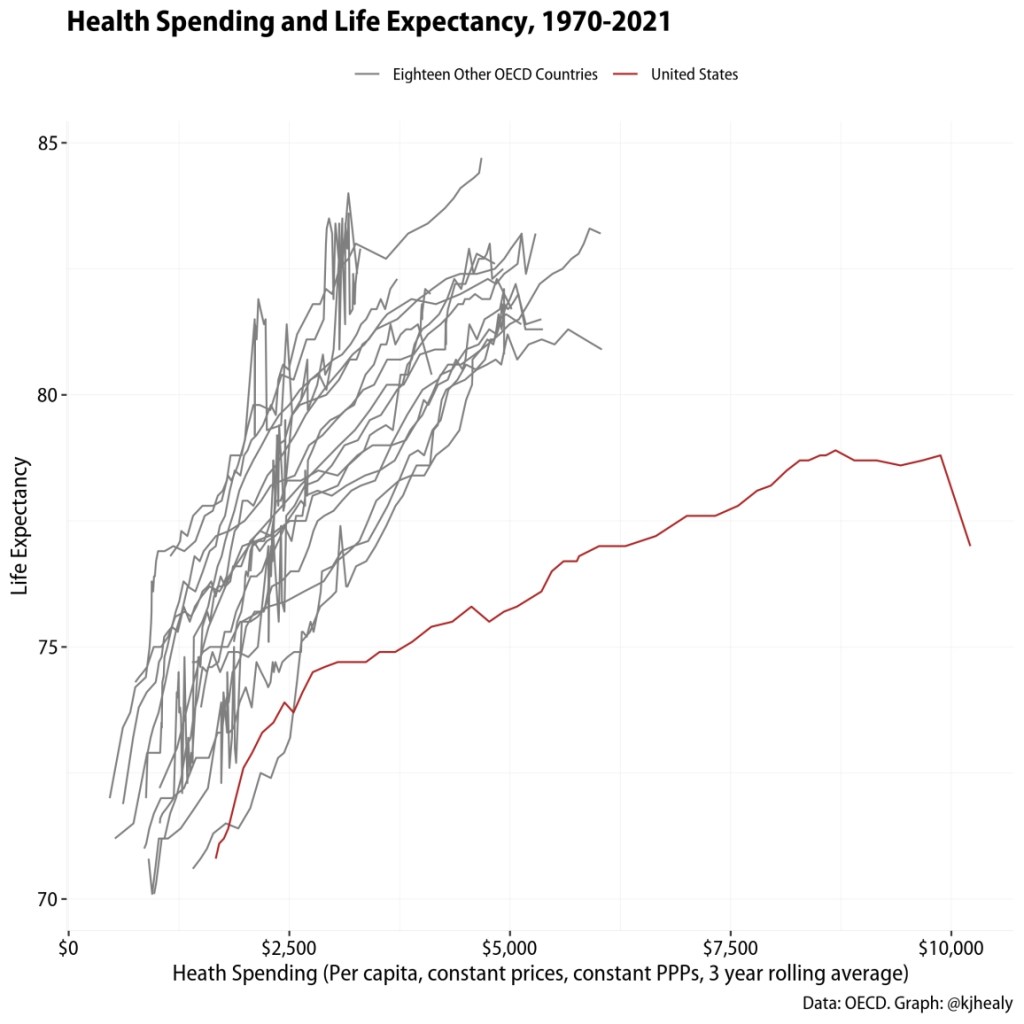
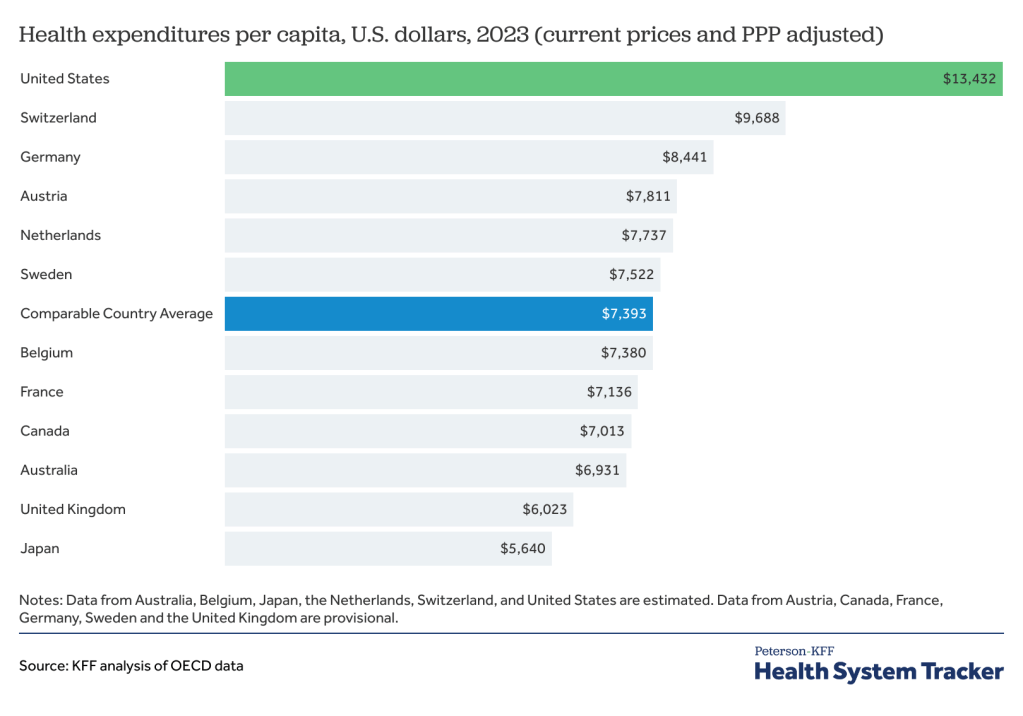
Yet the USA spends significantly more on health care than the rest of the world:
Americans also smokes fewer cigarettes than other OECD countries. For example, USA: 8.8% of the population are smokers, France 25.4%.10 And, while at 9.5 liters per person per year the US does consume quite a bit of alcohol compared to other OECD countries, it’s not as much as France (10.8 liters) or Germany (10.6 liters).11
What is the explanation for the American Paradox? Rivers of ink have been spilled on this subject, but in my opinion the most important reason is cultural. The United States was founded by people, mostly English initially, who were seeking a country where there were no restrictions on pursuing individual happiness. This culture of rugged individualism has been the impetus for amazing innovation and the creator of enormous fortunes for some. But it has also resulted in a very unequal society, with little in the way of a safety net compared to other wealthy nations.

The stress and uncertainty of living in such a society manifests itself in poor health outcomes at all levels, not just for poor people. Even the very wealthiest Americans have shorter lifespans than equivalent Europeans.12 The lack of social cohesion means that there is not the political will to implement so many of the measures that so many people living in other countries take for granted, such as affordable housing, good public transportation, and, above all, a comprehensive national health system based on public health, not profit.

Life in America is very expensive. Although most Americans have some form of health insurance, they pay very high premiums, deductibles, and co-pays. The prices of medications are not regulated. Insurance of any type is very expensive. There is a massive housing shortage (4.5 million homes), and what is available is very expensive.13 Public transportation is sporadic, expensive, and seemingly designed to punish people for not driving a car. Mobile phones are expensive. Internet service is expensive. The majority of Americans live from paycheck to paycheck and don’t have the means to cover a $1,000 emergency expense.14 Many Americans work two jobs to pay the bills. So it’s no surprise that Americans have to work so much harder to make ends meet than Europeans do, and their health and life expectancy suffers accordingly.
As for the French Paradox, it’s not really paradoxical. French food is not actually very healthy — the French diet consists of a lot of refined carbohydrates, meat, and sweets, and not much in the way of fresh fruit and vegetables.15 France does have a growing problem with obesity, for the same reason as the rest of the world: too much fast- and calorie-dense ultra-refined foods. But what they do have going for them to offset these drawbacks are:
• A culture of long (some might say too long!) family meals, high-quality food, smaller portions and no snacking between meals. Children learn this from an early age. The only snack is “le goûter” — the after-school snack “pour combler la fringale de quatre heures” (to fill the ravenous hunger of 4 pm).
• Frequent shopping for fresh food in small shops and street markets.
• Cities designed to privilege walking, biking, and using public transportation over driving cars.
It is my fond hope that Americans one day wake up and demand policies that will put an end to the American Paradox. But I’m not holding my breath.
- https://www.gov.ca.gov/2025/04/23/california-is-now-the-4th-largest-economy-in-the-world/ ↩︎
- https://en.wikipedia.org/wiki/OECD ↩︎
- https://www.worldometers.info/demographics/life-expectancy/ ↩︎
- https://www.cia.gov/the-world-factbook/field/infant-mortality-rate/country-comparison/ ↩︎
- https://data.who.int/indicators/i/C071DCB/AC597B1 ↩︎
- https://www.who.int/data/gho/data/indicators/indicator-details/GHO/estimated-road-traffic-death-rate-(per-100-000-population) ↩︎
- https://en.wikipedia.org/wiki/World_Health_Organization ↩︎
- https://en.wikipedia.org/wiki/List_of_countries_by_obesity_rate ↩︎
- https://en.wikipedia.org/wiki/List_of_countries_by_average_annual_labor_hours ↩︎
- https://data-explorer.oecd.org/vis?lc=en&df[ds]=dsDisseminateFinalDMZ&df[id]=DSD_HEALTH_LVNG%40DF_HEALTH_LVNG_TC&df[ag]=OECD.ELS.HD&df[vs]=1.0&dq=.A…..&pd=2010%2C&to[TIME_PERIOD]=false&vw=tb ↩︎
- https://data-explorer.oecd.org/vis?lc=en&df[ds]=dsDisseminateFinalDMZ&df[id]=DSD_HEALTH_LVNG%40DF_HEALTH_LVNG_AC&df[ag]=OECD.ELS.HD&df[vs]=1.0&dq=.A…..&pd=2010%2C&to[TIME_PERIOD]=false&vw=tb ↩︎
- https://www.news-medical.net/news/20250407/Even-rich-Americans-live-shorter-lives-than-poor-Europeans-study-finds.aspx ↩︎
- https://www.uschamber.com/economy/the-state-of-housing-in-america ↩︎
- https://www.forbes.com/advisor/banking/living-paycheck-to-paycheck-statistics-2024/ ↩︎
- https://www.sante-actu.com/francais-consomment-fruits-legumes-alimentation-quotidienne/ ↩︎
 Barbara and Joe Abroad